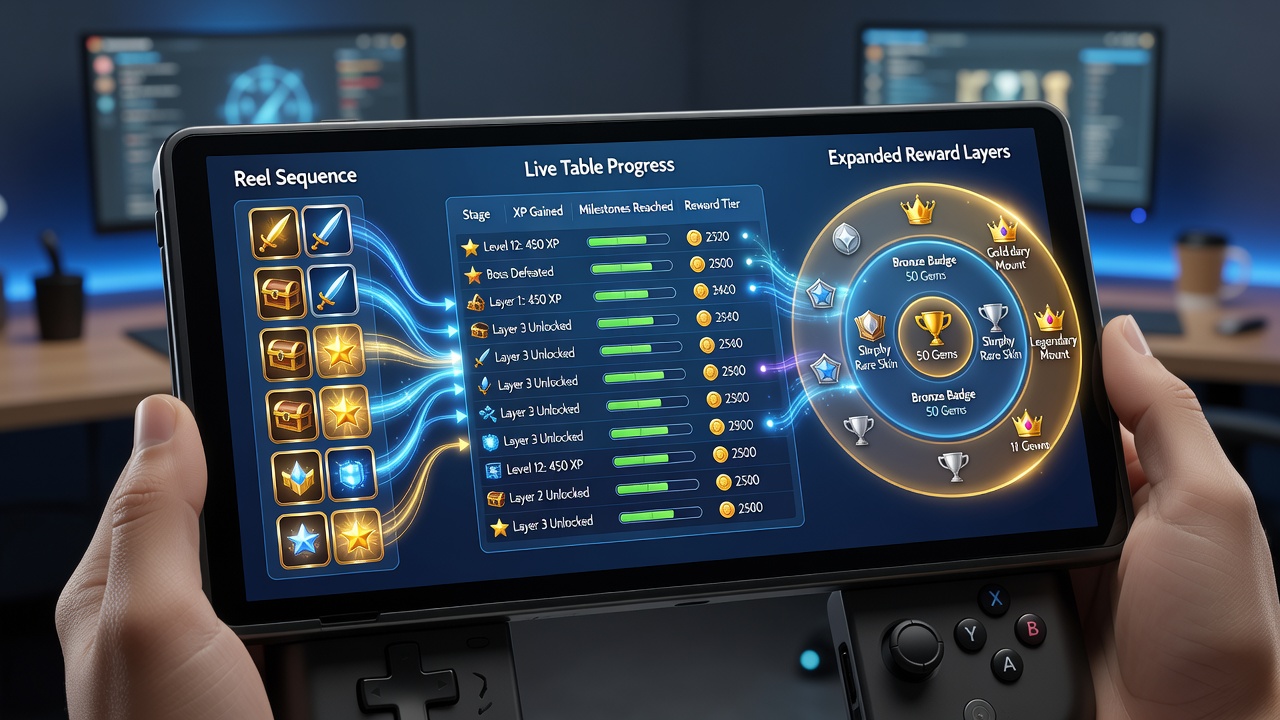
Integrating Reel Sequence Milestones With Live Dealer Advances Across Handheld Reward Systems
Developers have begun linking achievements earned through reel sequences directly to progress markers in live table environments on handheld platforms, and this integration creates additional layers of rewards that activate once certain combined thresholds are met. Data from industry reports indicate that such systems appeared more frequently in mobile applications during the first half of 2026 as operators sought ways to maintain user engagement across multiple game types without requiring separate loyalty programs for each format.
Mechanics of Cross-Format Progress Tracking
Reel sequence achievements typically accumulate through repeated spins that meet criteria such as consecutive wins, specific symbol combinations, or volume-based targets, while live table progress registers through hands played, dealer interactions completed, or betting patterns maintained in real-time sessions. When these two streams feed into a single tracking layer, players advance shared meters that unlock features including multiplied payouts, exclusive table access, or accelerated point earnings. Observers note that handheld devices facilitate this connection because session data transfers instantly between app sections without the latency issues sometimes encountered on desktop systems.
Studies conducted by research institutions show that operators in several U.S. states implemented these unified meters by August 2026, and the approach allowed users to carry momentum from one game category into another within the same application environment. For instance, completing a reel sequence challenge might automatically credit progress toward a live blackjack table milestone, thereby expanding the total reward pool available at each tier.
Technical Requirements for Seamless Integration
Backend systems must synchronize reel and table data streams in real time, which requires robust APIs capable of handling simultaneous inputs from slot engines and live dealer platforms. Gaming associations have documented that successful implementations rely on cloud-based servers positioned near regional data centers to minimize delays during peak usage periods. Those who have examined these architectures report that encryption standards meet or exceed regulatory benchmarks set by bodies such as the Nevada Gaming Control Board and equivalent agencies in other jurisdictions.
Handheld hardware capabilities also influence how deeply these connections can run, because processing power and battery efficiency determine whether complex tracking algorithms operate continuously without interrupting gameplay. Figures released by device manufacturers reveal incremental improvements in mobile chipsets that support such dual-format monitoring by mid-2026.
Regional Adoption Patterns Observed in 2026

Markets in North America and parts of Europe displayed differing timelines for rollout, with some Canadian provinces incorporating these features ahead of certain U.S. states due to variations in licensing frameworks. Academic papers analyzing adoption rates highlight that operators prioritized regions where mobile gaming already represented a substantial share of total revenue, thereby maximizing the impact of cross-format reward layers. By August 2026, several applications had introduced tiered unlock sequences that combined reel and table metrics into single visual dashboards visible on both portrait and landscape orientations.
Trade group summaries further indicate that player retention metrics improved in environments where progress carried across game types, although exact percentages vary by operator and market conditions. Regulatory filings from the Australian Communications and Media Authority provide additional context on how similar integrations were tested in that region during the same period.
Future Development Directions
Engineers continue refining algorithms that predict optimal reward triggers based on aggregated reel and table data, and these refinements aim to balance accessibility with challenge levels across different player segments. Industry organizations such as the European Gaming and Betting Association have hosted discussions on standardizing data formats that would allow smoother transfers between reel sequences and live table sessions when users switch devices mid-session.
Evidence from pilot programs suggests that expanded reward layers tied to combined progress can increase session duration without raising average bet sizes, and this outcome aligns with broader trends toward diversified engagement tools in handheld gaming. Continued monitoring by academic researchers will determine how these systems evolve as new hardware and regulatory updates emerge.
Conclusion
The connection between reel sequence achievements and live table progress has produced measurable expansions in reward structures available to handheld users, and operators continue adjusting these systems based on performance data collected through 2026. Regulatory oversight and technical advancements together shape how deeply such integrations penetrate different markets, while ongoing studies track their effects on player behavior across regions.